
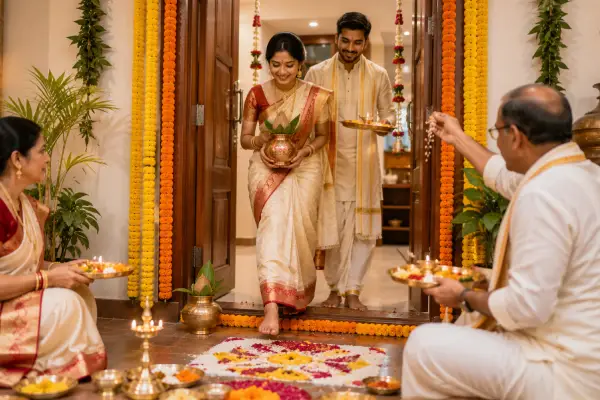
Griha pravesh is the ceremony performed when a family enters a new home for the first time, and the muhurat is the auspicious window chosen for that entry. Everything else on the day is arranged around it.
We decorate a lot of these in Kolkata, and the muhurat is the reason griha pravesh is the most logistically awkward booking we take — so it is worth understanding.
How the muhurat is chosen
A priest works from the family’s details and the panchangam, the Hindu almanac used to identify auspicious moments for weddings, housewarmings and other ceremonies. What comes back is usually a narrow window, sometimes only twenty or thirty minutes, and often before sunrise.
Broadly, the favoured periods fall in months such as Baisakh, Jyeshtha, Magh and Phalgun, with certain months avoided entirely. Specific lunar days and star positions are ruled in or out. Two families buying flats in the same building can easily get dates three months apart.
The practical consequence: you cannot move a griha pravesh to a convenient Saturday. If the muhurat is 5:40 on a Tuesday morning, that is when it happens, and every vendor works backwards from it.
What happens at the threshold
The sequence varies by family and region, but the common shape is this:
- A Ganesh puja outside, before anyone crosses.
- The kalash — a pot of water with mango leaves and a coconut — is carried in by the woman of the house, usually with her right foot crossing first.
- Boiling milk on the new stove until it overflows, which marks abundance. This is often the first thing cooked in the house.
- A havan or Satyanarayan puja inside, depending on the family.
- Feeding guests and family — the informal part, and usually the longest.
What has to be decorated, and why it is fresh
The threshold carries the ritual, so it carries the decoration: a fresh marigold and mango-leaf toran across the door frame, garlanding down both edges, alpana or rangoli at the entrance, and the puja corner with kalash decoration.
This is the one service where we use real marigold throughout and will not substitute artificial. Fresh flowers and mango leaf at the threshold are part of the ceremony, not decoration around it. Everywhere else on our site we recommend artificial for solid practical reasons — griha pravesh decoration is the exception, deliberately.
Planning around an early muhurat
- Confirm building access the night before. New buildings often have a guard who has not been told, and a locked gate at four in the morning stops everything.
- Flowers are sourced that morning. Kolkata’s flower markets open very early, which is what makes a dawn muhurat possible at all.
- Check whether the lift is commissioned. In new construction it frequently is not, and a tenth-floor flat changes the timeline considerably.
- Tell your priest and decorator the same timing. Obvious, and the thing that most often goes wrong.
After the entry
The fresh work stays with the home rather than being collected — only stands and frames come back. Many families follow griha pravesh with a Satyanarayan puja in the following weeks, and a housewarming gathering after that, both of which are lighter setups.
If you want a sense of cost before calling, the griha pravesh figure sits at the fresh-flower rate on our pricing page, because the whole service is fresh.
