
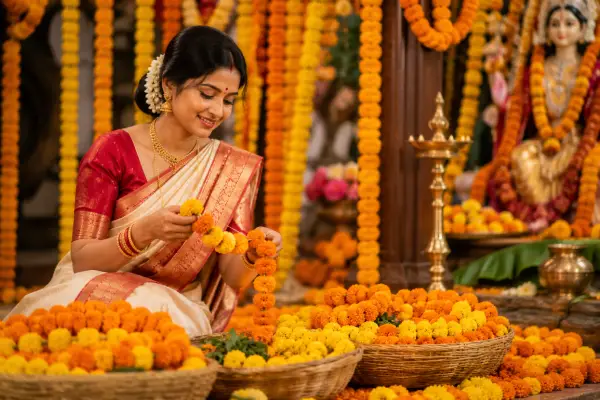
Genda phool is the Bengali and Hindi name for marigold, the flower used in more Indian ceremonies than any other. It is in the haldi paste ceremony, strung across doorways at griha pravesh, heaped at puja altars, wound around wedding mandaps and sold by the kilo in every Kolkata market before every festival.
We buy and hang more of it than anything else, so here is what is actually worth knowing.
Why marigold, and not something else
Three reasons, and only one of them is symbolic.
It holds up. A marigold head keeps its shape and colour for a day or more off the plant, in heat, without water. Most flowers of that size do not. For a ceremony that runs from dawn to midnight, that is the whole argument.
It is cheap and constantly available. Marigold is grown across India year-round at enormous scale, specifically for ritual use. It is one of the few flowers where you can order forty kilos on a day’s notice in Kolkata and actually get it.
It is the right colour. Yellow and orange are the auspicious colours for most Hindu ritual, and marigold delivers both in a flower that strings easily into garlands and torans.
The varieties you will actually see in Kolkata
- African marigold — the big dense round heads, up to about three inches. This is what garlands and backdrop panels are made from.
- French marigold — smaller, flatter, often two-toned rust and yellow. Used for scattered floor work and urli floats.
- Loose petals — sold separately by weight for alpana, floor decoration and the path a bride walks.
Prices swing hard with the festival calendar. In the week before Durga Puja or Diwali, marigold can cost three to four times its ordinary rate, which is worth knowing if your function falls next to a festival.
Where marigold is used
Haldi and gaye holud. Marigold is the base colour of nearly every haldi decoration — backdrop panels, hanging strings, urli floats.
Griha pravesh. Fresh marigold and mango leaf across the door frame is part of the ritual, not decoration around it. This is the one service where we will not substitute artificial, whatever the budget. See griha pravesh decoration.
Puja and pandals. Altar work, deity garlanding and pandal decoration across the puja calendar.
Weddings. Mandap pillars, entrance torans, and the mala badal garlands.
Fresh or artificial genda phool
Honest answer: it depends entirely on whether the flower is being offered or being looked at.
If marigold is part of the ritual — handled, offered, placed at an altar, hung at a threshold — use fresh. Artificial has no place there, and we say so even when a client asks for it.
If it is structural — a backdrop panel, mandap pillars, hanging strings that nobody touches — premium artificial marigold is usually the better call. It holds an exact shade across a whole setup, does not shed into turmeric paste at a haldi, survives twelve hours of Kolkata heat, and costs materially less at scale.
Most families we work with end up using both, and that is the right answer rather than a compromise.
Making fresh marigold last the day
- Buy the morning of, not the night before. A day old is visible.
- Keep it out of direct sun until it goes up. Boxes in the shade, not on a terrace.
- Mist strings lightly rather than soaking them — wet marigold browns at the edges.
- Hang overhead work last. It dries fastest because heat rises.
More on this in our note on keeping flowers fresh through a long function.
The botanical background — marigold is the genus Tagetes, originally from the Americas — is covered in the Wikipedia entry on Tagetes, which also notes the scale of Indian cultivation for religious use.
