
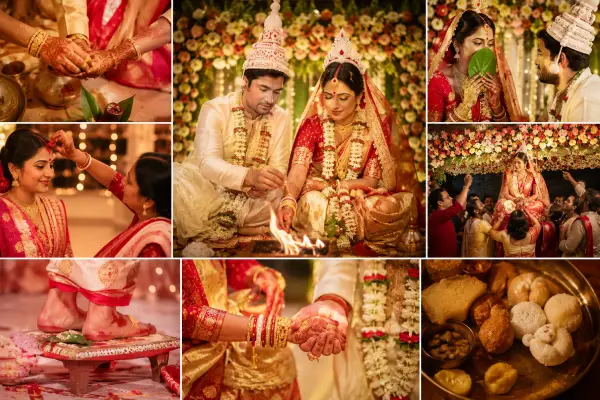
A Bengali wedding runs across roughly a week, in a fixed sequence of rituals. If you are attending one, marrying into one, or planning the decoration for one, this is the order things actually happen in.
We build setups for these every season in Kolkata, so this is written from the practical side as much as the traditional one.
Before the wedding day
Aashirbaad
The formal blessing. Elders from each family visit the other’s home and bless the couple with rice and trefoil leaves. This is when the marriage is effectively confirmed.
Aiburobhat
The last meal eaten as an unmarried person, hosted separately by each family. Floor seating, a full fish thali, close family only. We have written about what aiburobhat involves in more detail.
Gaye holud
The Bengali turmeric ceremony. Turmeric paste ground at the groom’s house is carried to the bride’s, and both are anointed with it. It is bright, loud and messy, which is exactly why the decoration has to be built to survive it — marigold-led, nothing that stains badly, and seating people can crowd around. See haldi decoration in Kolkata for how those setups are put together.
Dodhi mangal
At dawn on the wedding day, the couple are fed curd and flattened rice at their own homes — the last food before the ceremony, since both fast until the wedding is complete.
The wedding day
Bor Jatri and Bor Boron
The groom’s party travels to the venue, and the bride’s mother welcomes him with a ceremonial tray. The car matters here more than people expect: it leads the procession and is photographed constantly. Wedding car decoration is booked for exactly this moment.
Potto Bastra and Saat Paak
The groom is seated at the mandap and given new clothes. Then the bride, seated on a low wooden stool called a piri, is carried by her brothers and uncles and circled seven times around the groom — saat paake ghora. She keeps her face covered with betel leaves throughout.
Shubho drishti
The betel leaves come down and the couple look at each other for the first time as bride and groom, in front of everyone. This is the single most photographed second of a Bengali wedding, and it is the reason we build mandaps with a wider front opening and a shallower canopy than the standard North Indian design — a deep canopy puts the moment in shadow and blocks the sightline.
Mala Badal
The couple exchange flower garlands, three times, while being lifted by their families. The garlands are made fresh; this is one of the few parts of a modern Kolkata wedding where real flowers are still the norm.
Sampradan, Yagna and Saptapadi
The bride is formally given away, the sacred fire is lit, and the couple take seven steps around it. The mandap needs to stay accessible to the priest through all of this, which is the practical constraint that shapes the whole structure.
Sindoor Daan and Ghomta
The groom applies vermilion to the bride’s hair parting, and she covers her head with a new saree. The wedding is complete at this point.
After the wedding
Bidaay and Bodhu Boron
The bride leaves her family home, and is welcomed at the groom’s with a ceremonial tray, a bowl of milk and alta dye for her feet.
Kaal Ratri and Bou Bhat
The couple spend the first night apart by tradition. The following day the bride serves a meal to the groom’s family, and in the evening comes the reception — the largest gathering of the whole week. The first night room is decorated during that reception, while the family is out.
What this means for planning
Six of these rituals need decoration, across at least four days and often three different addresses. Booking them as one job rather than separately is not just cheaper — it is the only reliable way to get the colours to match, because artificial flower shades vary between suppliers.
The Wikipedia article on Bengali Hindu weddings covers regional variations, which are real: no two families do all of these the same way, and plenty skip some entirely.
For what a full wedding costs to decorate in Kolkata, our pricing page has the actual starting figures.
