
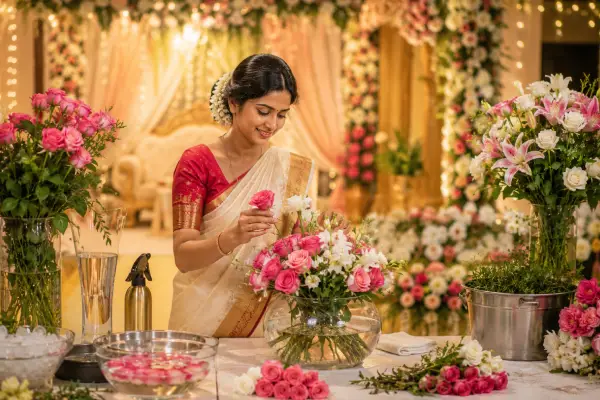
Fresh flower decoration looks its best for about five to six hours, and Kolkata heat shortens that. A function that starts at nine in the morning and finishes near midnight is asking more of fresh flowers than they can give — so the real skill is knowing what to protect, what to replace, and what should never have been fresh in the first place.
This is what we actually do on the day.
Before the flowers arrive
Buy on the morning, not the night before. One day old is visible in photographs, particularly at the petal edges. Kolkata’s flower markets open before dawn precisely because of this.
Keep everything boxed and shaded until it goes up. The most common cause of wilted decoration is not the function — it is flowers sitting on a sunny terrace for two hours during setup.
Cut stems at an angle, under water where you can. A flat cut sits against the bottom of the bucket and stops drinking. The general principles here are the same ones the cut flower trade uses — harvest in the cool part of the day and get stems into water as fast as possible.
During setup
- Build structure first, flowers last. Frames, fabric, stands and lighting all go up before a single flower, so the flowers spend the least possible time waiting.
- Overhead work goes up last of all. Heat rises; hanging strings dry faster than anything at floor level.
- Mist, do not soak. A light mist buys hours. Soaking browns marigold at the edges and spots rose petals.
- Keep water sources at the base. Floral foam, hidden tubes and urlis with real water all extend the life of arrangements that sit in them.
During the function
There is not much you can do once guests arrive, which is why the choices before matter. Two things still help: keep fans and air conditioning off the flower work rather than pointed at it — moving air dries petals faster than still heat — and have a small reserve of loose blooms to swap into the most visible arrangements before the main photography.
What to stop making fresh
Being straightforward about it: some things should not be fresh at all for a long function.
- Backdrops and panels. The largest surface, the least handled, and the first to look tired. Use premium artificial here and spend the fresh budget elsewhere.
- Mandap pillars and canopies. Structural, high up, and photographed all evening.
- Car decoration. A bridal car sits in the sun and moves at speed. Fresh flower car work is beautiful for the first few hours and rough by the reception. See wedding car decoration.
What should stay fresh
- Anything offered or handled in a ritual. Puja flowers, garlands, threshold work at griha pravesh.
- Mala badal garlands. Worn, exchanged, and close to the camera.
- First night room work. The scent is most of the point — see first night room decoration.
- Short ceremonies. Anything under about four hours, where fresh will hold comfortably.
The honest summary
Mixing the two is not a compromise — it is what experienced decorators do. Artificial where the flower is scenery, fresh where the flower is part of the ritual or close to the guests. Families who insist on fresh throughout for a full-day wedding almost always spend more and end the night with decoration that photographs worse than the mixed approach would have.
If you are weighing this up for a specific function, tell us the timings and we will say which parts are worth doing fresh. Our pricing page has the starting figures for both.
