
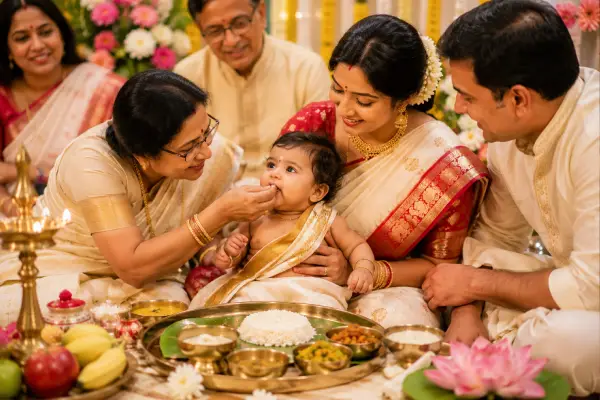
Annaprashan is the Hindu rite of passage marking a baby’s first taste of solid food — usually rice — after months of only milk. In Bengali families it is called mukhe bhaat, literally “rice in the mouth”, and it is one of the warmest family gatherings in the calendar. It is also widely called the rice ceremony in English.
Families in Kolkata ask us about this every week while booking, so here is the whole thing plainly.
When annaprashan happens
Traditionally the ceremony falls in an even month for a girl and an odd month for a boy, most often between six and nine months old. The exact date is set by a priest against the family’s almanac, which is why two babies born a week apart can have ceremonies a month apart.
Practically, families choose a date once the baby is sitting up steadily. That matters more than it sounds: the child sits in a decorated chair through the ritual and the photographs, and a baby who cannot yet sit unsupported makes for a difficult morning.
Who feeds the first rice
The mama — the mother’s brother — traditionally gives the first mouthful. In many families the maternal grandfather or another senior relative does it instead. The food is usually payesh, a rice pudding, sometimes with a small portion of plain rice, ghee and a few ritual items on a brass thali.
After the feeding there is often a small game: objects are placed in front of the child — a book, a coin, a pen, a clump of earth — and whatever the baby reaches for first is said to hint at their inclination. Nobody takes it seriously and everybody photographs it.
What the day looks like
Most annaprashans start early, because the muhurat is usually in the morning. A priest performs a short puja, the feeding happens, and then the family eats — a full Bengali lunch, often the main event for the guests. Numbers range from twenty relatives in a flat to two hundred in a community hall.
What gets decorated
A decorated chair for the baby at the right height, a floral backdrop carrying the child’s name, a decorated table for the annaprashan thali and ritual items, doorway work, and a separate photo corner so guests are not queuing at the main setup between rituals. We cover exactly this on our annaprashan decoration in Kolkata page, including what it costs.
Annaprashan, mukhe bhaat, rice ceremony — one ceremony
These are three names for the same ritual. Annaprashana is the Sanskrit name used across Hindu communities. Mukhe bhaat is the Bengali name. “Rice ceremony” is the English shorthand most Kolkata families now use when talking to vendors. If you are booking anything, all three will be understood.
The Wikipedia entry on annaprashana covers the ritual’s history and its practice across other Indian communities, where it goes by names such as choroonu in Kerala and bhaat khulai in parts of the north.
Planning notes from doing these every month
- Book the hall before the decoration. Morning slots in community halls go early, and the muhurat is not negotiable.
- Tell your decorator the baby’s age. It decides whether a high chair or a low cushioned platform is right, and the chair height drives every photograph.
- Send the name spelling in writing. Cut lettering for a backdrop cannot be corrected on the morning.
- Plan for early access. If the muhurat is at seven, the setup starts before five. Confirm the venue will actually be open.
If you are arranging one in Kolkata and want the setup handled, we cover the whole city from our base in Kasba and can quote from photographs of the space.
